Telescopus fallax Overview
Scientific name and common names
The European Cat Snake Telescopus fallax is a vigilant, sun-warmed silhouette along Cyprus’s rocky lanes and scrub. Its slender body, keen eyes, and quiet retreat from the day speak of a creature built for the margins between heat and shadow. The scientific name Telescopus fallax hints at its keen, telescoping gaze and cautious movements as dusk arrives.
- Scientific name: Telescopus fallax
- Common names: European cat snake
In Cyprus, its preferred haunts are sun-warmed ledges, rocky outcrops, and thorny maquis where it hunts by stalking lizards and small birds. Though rear-fanged and shy, it plays a vital role in controlling pest populations, a quiet testament to the balance of rural landscapes.
Taxonomy and classification
European Cat Snake Telescopus fallax commands Cyprus’s sun-warmed ledges and thorny maquis; a patient hunter of lizards and small birds, it embodies the quiet balance of heat and shadow in the island’s ecosystems.
Taxonomic overview: In the scientific hierarchy, this species belongs to the family Colubridae, the genus Telescopus, and the species epithet fallax. This placement highlights its rear-fanged lineage and distinct ocular adaptations that aid ambush predation at twilight.
- Family: Colubridae
- Genus: Telescopus
- Species: fallax
Understanding classification helps frame conservation and ecological roles—this snake’s presence signals Mediterranean habitat health and pest control services that help maintain rural Cypriot landscapes.
Identification and distinguishing features
Cyprus keeps a nocturnal envoy in its limestone crevices—the European Cat Snake Telescopus fallax. A patient ambusher of lizards and small birds, it moves with lithe grace along sun-warmed ledges as twilight drapes the island.
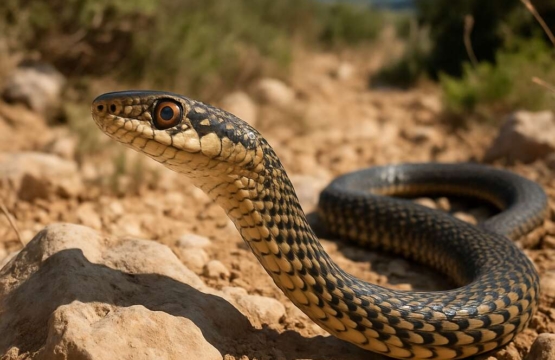
Identification and distinguishing features: The European Cat Snake Telescopus fallax is slender, grey-brown with irregular markings that help it blend into limestone and debris. Its eyes are large for a snake, hinting at twilight hunts.
- Rear-fanged dentition with mild venom
- Large eyes and slender head for dusk stalking
- Smooth scales and a variable grey-brown pattern
In Cyprus, encounters are flashes of patience and shadow—a reminder of ecosystems balancing heat and shelter. I’ve watched that faint movement along rock faces at dusk, where Telescopus fallax waits then glides away.
Geographic range at a glance
On Cyprus’s sun-warmed limestone, the European Cat Snake Telescopus fallax glides through dusk like a whispered thought—a patient envoy between rock and shade!
Geographically, the species threads the eastern Mediterranean: Cyprus anchors its eastern fringe, with southern Greece, western Turkey, and coastal North Africa following in its wake. Geographic range at a glance includes these cradlelands where calcareous ledges and limestone crevices shape its quiet routes.
- Cyprus
- Southern Greece
- Western Turkey
- Coastal North Africa
In Cyprus and beyond, the European Cat Snake Telescopus fallax favors limestone habitats and crevices, a patient ambush artist whose grey-brown pattern dissolves into debris during daylight and reappears at dusk with startling clarity.
Habitat and Range
Natural habitat types
On Cyprus’s sunlit limestone and carven gorges, the European Cat Snake Telescopus fallax glides through dusk like a whisper made flesh. It thrives on margins where heat cedes to shadow, a patient hunter with eyes bright as embers—endemic to a land of olives and wind.
Natural habitats for this enigmatic species cluster around sun-warmed refuges, where prey hides and predators pass unseen. The following habitats typify its haunt across the Mediterranean, including Cyprus:
- Dry maquis on limestone slopes that shed heat at night
- Rocky outcrops, cliffs, and sun-warmed ledges
- Edges of olive groves, vineyards, and seasonal streams
Across its broader range, this cat-hunting serpent threads from Iberian peninsulas to the eastern Mediterranean, preferring xeric terrain with seasonal cover. In Cyprus, it nests along southern-facing hillsides, limestone corridors, and hedged margins, slipping into dusk to pursue geckos and small lizards.
Geographic distribution and range map
Moonlit mountains, sun-warmed ledges—the European Cat Snake Telescopus fallax maps its presence across the Mediterranean like a whispered thread. In Cyprus, its reach favors southern exposures and limestone corridors where dusk softens into hunting light.
Across its broader range, the species threads from the Iberian Peninsula to the eastern Mediterranean, preferring xeric terrain that stores heat and quiet corners for ambush. A concise range map traces its shadows along coastal hills, river gorges, and scrubby belts that wink at the setting sun.
- Iberian Peninsula and southern Europe
- Eastern Mediterranean, including Cyprus
- Nearby Mediterranean islands and coastal hills
Climate and microhabitats
Heat is the quiet language of the European Cat Snake Telescopus fallax, spoken along Cyprus’s sun-washed slopes. “Heat is the quiet language of the land,” an old farmer told me, and this snake proves it—as dusk drifts over limestone ledges where it anchors its late-day rendezvous. In Cyprus, southern exposures and limestone corridors become refuges as daylight fades, a reminder that microhabitats shape a life as surely as a map does.
Across the broader Mediterranean, the climate nudges it toward xeric terrain that stores heat and offers ambush lanes. It favors coastal hills, river gorges, and scrubby belts where the day’s last warmth lingers.
- Limestone corridors and sun-warmed ledges
- Scrubby belts along coastal hills and river gorges
- Rock crevices and dry stone walls that shelter at night
These quiet pockets bind the land to the life of European Cat Snake Telescopus fallax, guiding its rhythm through Cyprus’s seasons with patient grace.
Behavior and Diet
Behavioral patterns and activity cycles
The European Cat Snake Telescopus fallax thrives in the Mediterranean’s half-light, where twilight becomes its playground and every rustle a potential meal. “The cat of the Mediterranean hunts in half-light,” quips a Cyprus-based herpetologist, and the sentiment sticks like a good pun to a damp rock.
Behaviorally, this snake is an elegant ambusher: patient, precise, and somehow theatrical. It relies on camouflage, short bursts of speed, and a rear-fanged bite to subdue prey. Diet-wise, it favors lizards, geckos, small rodents, and occasionally birds, slipping from crevice to crevice with catlike grace.
Typical activity cycles and hunting approaches include:
- Crepuscular activity with dusk and dawn as prime hunting windows
- Opportunistic foraging in rock piles, walls, and low vegetation
- Seasonal shifts toward nocturnal activity during extreme heat
Feeding habits and prey types
“The cat of the Mediterranean hunts in half-light,” a Cyprus-based herpetologist notes, and the line lands like a warm dusk breeze. The European Cat Snake Telescopus fallax moves with the theatre of a quiet street performer: patient, precise, and startling when it strikes. It relies on camouflage among sun-browned rocks, quick short bursts, and a rear-fanged bite to subdue its quarry, then slips away with catlike grace. Its diet favors small, agile prey.
Feeding habits of the European Cat Snake Telescopus fallax revolve around a handful of familiar prey:
- Lizards and geckos
- Small rodents
- Occasional birds
This opportunistic foraging suits Cyprus’ rocky crevices and sun-warmed walls, where it slips from shadow to shadow with quiet confidence.
Venom and defense mechanisms
The European Cat Snake Telescopus fallax moves with the patience of a theatre ghost, awaiting half-light and a breath of shadow. I have stood in Cyprus’ dusk and felt its gaze test the air, then strike with quiet inevitability. Its behavior unfolds like a ritual: still, then sudden, stalking with the quiet gravity of a street performance. In Cyprus’ sun-warmed crevices it tests the air, a patient hunter whose appetite remains opportunistic yet efficient.
- Rear-fanged venom helps subdue small, agile prey with a precise bite.
- Camouflage among sun-warmed rock and shadow heightens ambush success.
- When threatened, it coils and retreats into cracks, using terrain as defense.
- Venom is tailored for vertebrates, making encounters with large mammals unlikely.
In the Cyprus night, this patient predator remains a whispered force, a reminder that venom can be a surgical instrument of patience rather than a spectacle of fear.
Predators and survival strategies
‘Patience is the predator’s weapon,’ a Cyprus naturalist told me, and the European Cat Snake Telescopus fallax proves the point as dusk settles. It moves with deliberate grace, waiting in half-light, then striking with quiet inevitability. Its stalking reads like a ritual: still, then sudden, as it targets small lizards, geckos, and other nimble prey that skitter along sun-warmed crevices.
Predators in the Cyprus night include birds of prey and larger snakes. To endure, this species relies on cryptic coloration that blends with rock and shadow, retreating into cracks and using terrain as cover. It treks with patient, measured steps, relying on ambush and precise timing to survive.
- Crevice-dwelling retreats and rock sunspots for ambush readiness
- Cryptic camouflage that dissipates movement during patrols
- Opportunistic prey selection, from lizards to small mammals
Reproduction and Lifespan
Breeding season and mating behaviors
Across Cyprus’s sunlit scrub, the European Cat Snake Telescopus fallax keeps its secrets close, as if the heat itself were syllables in a love poem. “Life glides on the edge of warmth,” a field note murmurs, and the breeding season unfurls with longer days; males drift in search of receptive females, weaving quiet courtship into the afternoon hush.
- Courtship includes tail flicks, slow coils, and pheromone cues that travel through the warm air.
- Females lay 2–6 eggs after mating; incubation typically 40–60 days in sheltered, thermally stable sites.
- In the wild, Telescopus fallax often lives several years; captivity can extend life into a decade or more.
In Cyprus, this quiet drama of reproduction and lifespan unfolds with the island’s microclimates, offering observers a rare glimpse into the endurance of the European Cat Snake Telescopus fallax.
Eggs, incubation, and hatchlings
In Cyprus, the European Cat Snake Telescopus fallax guards a quiet renewal—the moment a female seals her eggs and the world waits for hatchlings. Eggs are typically laid in sheltered spots after mating, with a clutch of 2–6 and an incubation window of 40–60 days in thermally steady microhabitats.
- Clutch size: 2–6 eggs
- Incubation: about 40–60 days
- Hatchlings: emerge ready to navigate crevices and sunlit edges
In the wild, Telescopus fallax lives for several years; in captivity, this quiet survivor can reach ten years or more—the cycle of life punctuated by heat, shelter, and chance encounters with the island’s elusive rhythms. I watch it unfold with a patient awe!
Lifespan in the wild and captivity
In Cyprus, life nudges the landscape with a patient ritual—the European Cat Snake Telescopus fallax pursues reproduction with a rhythm as ancient as the island’s limestone cliffs.
Mating follows warm, sun-washed days; courtship is quiet, with slow, deliberate movements across sunlit ledges. After this, offspring appear in a secluded space where the heat and shelter converge.
- Wild lifespan: several years
- Captivity lifespan: ten years or more
Cyprus’ coastlines and limestone plains thus cradle a species tuned to microhabitats and seasonal shifts.
Conservation and Human Interaction
Conservation status and threats
Across Cyprus’s sunlit limestone gorges, the European Cat Snake Telescopus fallax glides through a world whispering between scrub and stone. Its conservation status varies by region, but where maquis and pine forests persist, we glimpse a creature pressed by habitat loss, shifting fires, and encroaching development. I’ve walked those trails and felt the sense of quiet urgency—this snake embodies the fragility of our island’s ecological threads!
Human interaction and threats converge on Cyprus’s hills. Among pressure points, habitat alteration, road mortality, and mistaken persecution shape Telescopus fallax.
- Habitat loss and fragmentation
- Road mortality and traffic collisions
- Persecution and misinformation
A mindful regard for these forces helps preserve Cyprus’s natural heritage.
Threats from habitat loss and collection
‘Habitat is the last vote we have for Telescopus fallax,’ a Cyprus ecologist once told me. In Cyprus’s sun-scorched gorges and patchy maquis, the European Cat Snake Telescopus fallax glides through a world thinning at the edges. Habitat loss and fragmentation squeeze its micro-habitats, while shifting fires erase the sheltered crevices it relies on. Even small changes to land use ripple through its daily life, nudging it toward marginal spots where survival is harder. The species clings to Cyprus’s remaining mosaics, but development and misperceptions threaten its quiet resilience. I’ve seen the signs on the ground, a quiet warning etched in burned hillside.
- Habitat loss and fragmentation
- Road mortality and traffic collisions
- Persecution and misinformation
A mindful regard for these forces helps preserve Cyprus’s natural heritage. The European Cat Snake Telescopus fallax remains a symbol of the island’s ecological fragility.
Human-wildlife interaction and safety tips
In Cyprus, every sunlit crevice tells a story of balance and fragility. The European Cat Snake Telescopus fallax glides through the maquis, a quiet ambassador of place. A Cyprus ecologist once said, ‘Habitat is the last vote we have,’ and that vote is cast on scorched hillside and sheltering rock crevices.
Conservation here is lived daily. Farmers, hikers, and families share the landscape with Telescopus fallax, learning to give it space and quiet. Observing from a distance, preserving scrub corridors, and avoiding disturbance are small acts that safeguard Cyprus’s natural heritage.
- Observe Telescopus fallax from a distance, letting it pass in peace.
- Avoid handling or relocation.
- Support habitat-friendly farming and report sightings to local groups.
These mindful practices help the island breathe—and the European Cat Snake Telescopus fallax endures.
Conservation efforts and responsible viewing or ecotourism
Cyprus’s sunlit scrub hides a patient diplomat: the European Cat Snake Telescopus fallax. “Habitat is the last vote we have,” a Cyprus ecologist reminds us, and that vote is cast on scorched hillside and sheltering rock crevices.
Conservation here is a daily practice, not a poster on a wall. Farmers, hikers, and families share the landscape with Telescopus fallax, guarding scrub corridors and quiet refuges where this quiet visitor can slip through unseen.
Responsible viewing in Cyprus blends curiosity with humility, supporting locally led ecotourism that values habitat and wildlife. When people walk softly through maquis, the island’s natural heritage breathes a little easier—and Telescopus fallax keeps its place in the island’s story.

 by
by 





Latest Comments