The Poetry of Self-DestructionFew organisms embody transience as completely as the Shaggy Ink Cap Coprinus comatus. Its lifecycle is compressed, dramatic, and unapologetically brief.
From emergence to dissolution can take less than forty-eight hours.
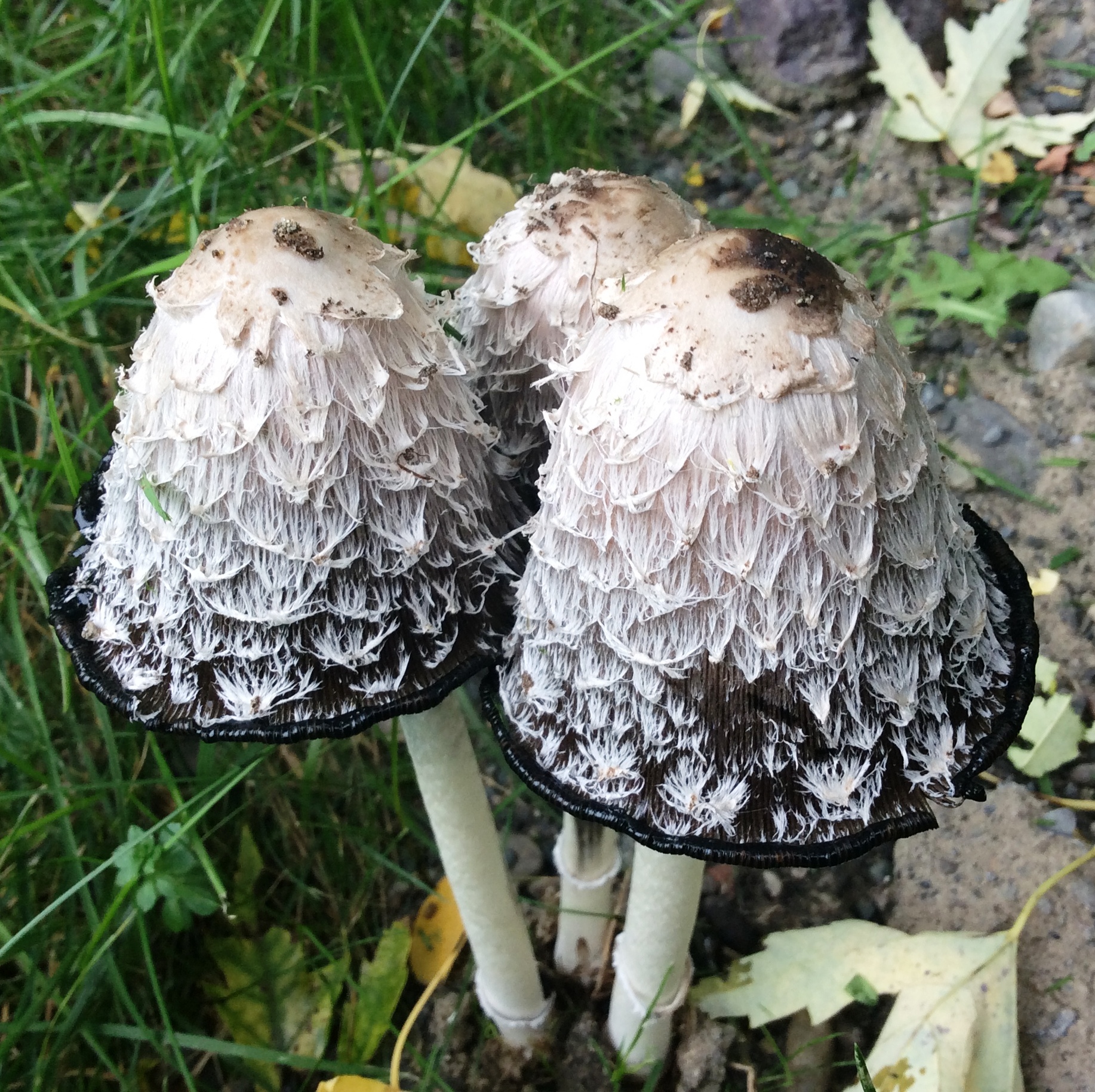
At first, it stands firm and pristine—white, tightly closed, confident in form. Then, as spores mature, enzymes trigger a process known as deliquescence: the cap and gills digest themselves, turning structure into fluid, solidity into ink.
The mushroom consumes itself
so that its future may spread.
There is something profoundly human in this act.
To give oneself away
for continuity.
For legacy.
For unseen tomorrows.
A Traveller’s Encounter
As a travel blogger, one learns to look down as often as out.
The Shaggy Ink Cap Coprinus comatus rewards those who walk slowly—those who wander village lanes after rain, who pause at the edge of a field, who notice the quiet revolutions happening at ankle height.
It appears unexpectedly, often in small clusters, like a gathering of scholars whispering secrets before vanishing. You might find it beside an old stone wall, near a vineyard track, or pushing through city grass as if urban order were merely a suggestion.
It is democratic in its beauty.
No remote pilgrimage required.
Edible—But Only in Youth
The Shaggy Ink Cap Coprinus comatus holds a curious dual reputation: both gourmet and ghost.
When young—before the gills darken—it is considered an excellent edible mushroom. Delicate in flavour, tender in texture, it has long been appreciated by foragers and cooks who understand its urgency.
Because urgency is everything.
Once picked, it must be cooked quickly. Hours, not days. Left unattended, it will continue its transformation, turning dinner plans into inky disappointment.
To eat this mushroom is to accept impermanence on the plate.
A meal that insists on presence.
Not All Ink Caps Are Alike
Though often confused with other ink caps, the Shaggy Ink Cap Coprinus comatus stands apart in both temperament and chemistry.
Unlike some of its darker cousins, it does not contain compounds that react dangerously with alcohol. This distinction matters, not just biologically, but symbolically: this is a mushroom that dissolves on its own terms, not in reaction to excess.
It asks for attentiveness, not abstinence.
Respect, not fear.
A Study in Form and Texture
Visually, the Shaggy Ink Cap Coprinus comatus is a lesson in restraint.
Its colours rarely stray beyond white, cream, and soft grey, yet its surface is alive with texture—scales lifting and curling like parchment in a breeze. The stem is hollow, fragile, ringed delicately, as if ornamented rather than reinforced.
This is not a mushroom built for endurance.
It is built for expression.
Ecology’s Quiet Worker
Beneath its elegance lies purpose.
The Shaggy Ink Cap Coprinus comatus is a saprotroph—a recycler of organic matter. It breaks down decaying plant material, returning nutrients to the soil, enriching the ground for what comes next.
In this way, it is less a solitary beauty
and more a quiet labourer,
dressed for a role few notice.
Where it grows, soil is alive.
Disturbed ground is healing.
Cycles continue.
Symbolism Written in Ink
It is no surprise that artists, philosophers, and naturalists have long been drawn to ink caps. The Shaggy Ink Cap Coprinus comatus, in particular, reads like a parable.
It rises immaculate.
It fulfils its function.
It dissolves without complaint.
No clinging.
No preservation.
No illusion of permanence.
In a world obsessed with longevity, it teaches grace in departure.
A Mushroom That Resists Domestication
Despite its culinary appeal, the Shaggy Ink Cap Coprinus comatus resists large-scale cultivation. Its timing is too precise, its biology too self-directed.
It appears when conditions are right.
And disappears when its work is done.
Perhaps this is its final lesson:
some things cannot be industrialised
without losing their soul.
Why It Captivates the Traveller’s Eye
To encounter the Shaggy Ink Cap Coprinus comatus while travelling is to witness a fleeting collaboration between weather, soil, and time.
Rain has fallen.
Temperature has softened.
The earth has opened a brief window.
Miss it, and you will never know it was there.
Catch it, and it will linger in memory far longer than its body remains.
This is the quiet reward of attentiveness—the gift given to those who move through landscapes not as conquerors, but as witnesses.
An Ending That Is Also a Beginning
By the next morning, the mushroom may be gone. In its place: dark stains on grass, faint traces of ink absorbed into soil, spores scattered invisibly into future.
Nothing dramatic remains.
And yet—everything continues.
The Shaggy Ink Cap Coprinus comatus does not demand admiration.
It earns it.
A gentleman in a shaggy coat,
tipping his hat to time itself,
then stepping gracefully
back into the earth.

 by
by 



Latest Comments