Serapias aphroditae in Cyprus: Where the Goddess Still Walks the Hills
There are flowers that decorate a landscape.
And then there are flowers that belong to it.
Serapias aphroditae in Cyprus is not merely an orchid—it is a whisper from antiquity, a living echo of myth and limestone, rising each spring from the island’s red-brown soils as if summoned by memory itself. To encounter it is not simply to observe a plant, but to stumble upon a moment where botany, history, and poetry converge.
This orchid does not shout for attention.
It waits.
And in waiting, it teaches.
An Orchid Named for a Goddess
The name alone carries weight. Aphroditae—of Aphrodite. The goddess whose story is inseparable from Cyprus, whose birth from sea-foam forever bound love, land, and legend. That this orchid bears her name feels less like taxonomy and more like recognition.
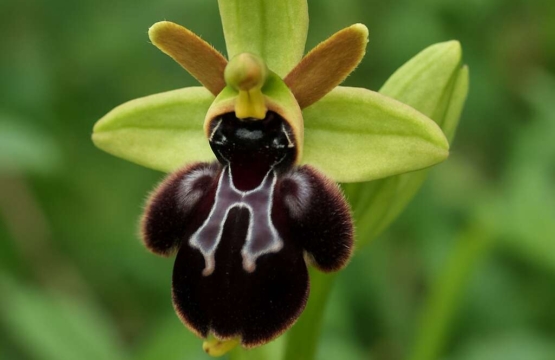
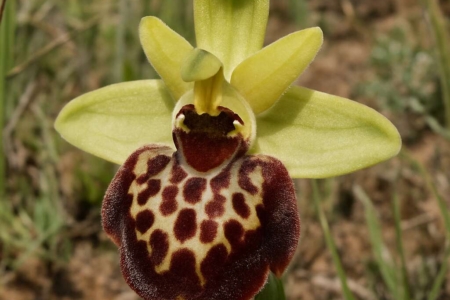
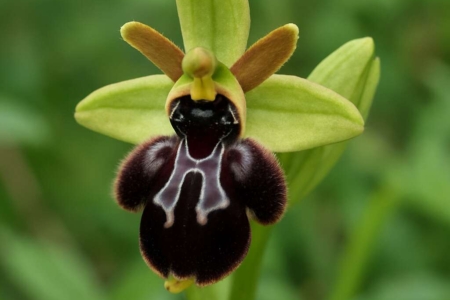
Serapias aphroditae in Cyprus blooms close to the ground, its hooded flower shaped like a sheltered chamber, as though inviting silence before admiration. Deep reds, wine-dark purples, and earthen tones dominate its form—colours drawn not from extravagance, but from the island itself.
This is beauty restrained.
Beauty that knows its power.
Where It Grows: Landscapes of Patience
To find Serapias aphroditae, one must leave the obvious paths. It appears in open meadows, rocky clearings, abandoned terraces, and lightly grazed land—places where human presence has softened rather than erased nature.
Across Cyprus, particularly in areas of low to mid altitude, the orchid rises among grasses and wild herbs, favouring balance over excess. It thrives where disturbance is minimal, where seasons still dictate rhythm.
In regions near Troodos Mountains foothills, and in quiet rural expanses of Cyprus, Serapias aphroditae finds its stage—never in crowds, never in haste.
It is a flower for those who walk slowly.
The Ritual of Spring
Spring in Cyprus is brief, intense, and generous. Rain-fed hills turn green, wildflowers rush to bloom, and then—almost suddenly—the heat returns to reclaim the land.
It is within this narrow window that Serapias aphroditae in Cyprus reveals itself.
From March to April, sometimes stretching into early May depending on altitude and rainfall, the orchid rises from winter’s silence. Its appearance feels ceremonial, like a rite performed at the edge of visibility.
Miss a week, and it may already be gone.
Such ephemerality lends the orchid its gravity. This is not a flower that waits for you. You must be present enough to meet it.
A Form Shaped by Strategy
The structure of Serapias aphroditae is no accident. Its helmet-like hood shelters the reproductive organs, while the elongated lip guides insects inward—not with nectar, but with promise.
Like many orchids, it practices deception. Pollinators are lured by shape, colour, and warmth rather than reward. This quiet trickery is not cruelty; it is adaptation refined over millennia.
In this way, Serapias aphroditae in Cyprus mirrors the island’s own history—surviving through subtlety, persistence, and strategic restraint.
Endemic, and Therefore Precious
This orchid is endemic. It belongs to Cyprus alone.
That singularity carries responsibility.
To speak of Serapias aphroditae in Cyprus is also to speak of fragility. Habitat loss, overdevelopment, intensive agriculture, and careless collection all pose threats to its survival. The orchid’s reliance on specific soil fungi for germination makes it particularly vulnerable to environmental disruption.
Once uprooted, it does not forgive.
Conservation here is not abstract. It is practical. It is local. It is urgent.
Encounter, Not Consumption
There is a temptation—especially in the age of instant sharing—to treat rare beauty as something to be taken, documented, or possessed.
Serapias aphroditae resists this impulse.
It asks only to be witnessed.
Photographed gently.
Observed quietly.
Left exactly where it stands.
Those who encounter Serapias aphroditae in Cyprus often speak of the moment in hushed tones, as though describing a private meeting. The experience feels earned, not granted.
This is not tourism.
It is communion.
Myth Made Botanical
Cyprus is a land where myth never fully retreated. Aphrodite’s presence lingers in sea caves, headlands, and springs—but perhaps nowhere is her spirit more subtle than in this orchid.
Serapias aphroditae does not embody love as spectacle. It represents love as endurance. As restraint. As intimacy between land and life.
In its downward-facing bloom, there is humility.
In its colour, desire tempered by earth.
In its timing, devotion to season.
It feels fitting that such a flower would carry her name.
Walking with Awareness
To seek Serapias aphroditae in Cyprus is to practice a different way of moving through landscape. One slows. One looks closely. One begins to notice not only what is present, but what is absent.
Trampled soil tells stories.
Overgrazed hills whisper warnings.
Untouched clearings feel suddenly sacred.
The orchid becomes a lens through which the island reveals its balance—and its vulnerabilities.
Why This Orchid Matters
In a world increasingly defined by scale and speed, Serapias aphroditae stands as a counterargument.
It reminds us that:
Endemism is irreplaceable
Subtle ecosystems hold immense value
Beauty does not need abundance to endure
Presence is more important than possession
Serapias aphroditae in Cyprus is not just a botanical curiosity. It is a measure of ecological health, a symbol of restraint, and a living testament to the island’s singular identity.
The Silence After the Bloom
By early summer, the orchid fades. Its flower withers, seeds scatter invisibly, and the land returns to gold and dust. To the untrained eye, nothing remains.
But beneath the soil, life waits.
That waiting is the lesson.
Cyprus has always been a place of waiting—between empires, between seasons, between tides. And like the orchid, it survives not by force, but by patience.
To know Serapias aphroditae in Cyprus is to understand something essential about the island itself: that its deepest beauty does not announce itself loudly.
It waits for those who are willing to look down, slow their steps, and listen to the quiet places where gods once lingered—and perhaps never truly left.

 by
by 


Latest Comments